

Welcome to the core of FIBCs
Products
We offer wide variety of FIBCs to satisfy the technical and regulatory requirements of different industries.


Standard 4 Loop Big Bags
The most standard FIBC in the market. Combination of a U shape panel fabric with two side panels. Suitable for all packaging groups.
Standard big bags comprise all big bag types with a standard construction of bottom, four walls and four corner loops

Cross Corner Big Bags
The Tubular Bag design is one of the most commonly used in flat packaging. This consists of a single piece of fabric made into a cylindrical shape and the two edges stitched together. Tubular Bags are most commonly used for storing and transporting very fine and sifted materials, such as wheat, flour or carbon.

Formstable Big Bags
(Baffle Bag, Q-Bag)
Formstable Big Bags are constructed with inner diagonal walls (baffles), which are sewn across the four corners and which ensure that the big bag keeps a rectangular shape when filled.
Advantages
-
Stability and optimal utilization of space
-
Optimized transport loading
-
Improved space utilization during warehouse storage
-
Enhanced stability during stacking, transportation and handling

Food Grade Big Bags
Food grade bags are made with 100% virgin polypropylene resin and food approved additives (UV , filler and color additives).
These FIBCs are manufactured under ISO22000 certificate with the HACCP program.
HACCP : Hazard Analysis of Critical Control Points

Electrostatic Big Bags
Concerning the aspects of the avoidance of electrostatic-ignition hazards, up to now four types of FIBCs (A, B, C and D) are in use according to their ability of charge dissipation and/or limiting the energy of possible discharges.
Some FIBC applications occur in potentially hazardous explosive atmospheres. Filling and Discharging creates static electricity. Fine powders with low (MIE) minimum ignition levels can create combustible dust clouds within the bag and surrounding environment.
Requirements

Ventilated Big Bags
If you need to safely transport your potatoes, onions, beans, grains, nuts, wood logs or a similar product, our Ventilated Big Bags (FIBCs with air stripes) are breathable,
Each FIBC can be tailor-made to suit your product’s properties and the circumstances of the transport so that your product arrives in the best condition possible.

UN Grade Big Bags
For storage and transport of hazardous materials, a standard big bag is not strong enough. For these kind of materials there need to be obeyed stricter regulations and they require a special big bag;
UN certified big bags.
These big bags are manufactured, tested and certified for a wide range of goods in environments where there is risk of fire, explosion, chemical burns, toxic contamination or environmental damage.
A UN big bag is specifically designed to transport/store hazardous materials and it must meet the various specifications and standards set out by the United Nations in order to be properly classified as UN bags.
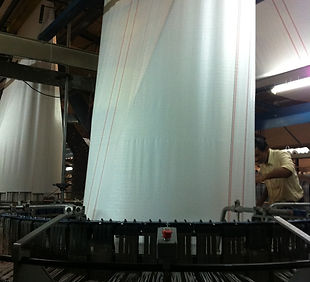
Fabric Types
The body of big bags are made from woven polypropylene fabric (cloth). Fabrics can be classified by;
-
Weaving technology ( Flat or circular)
-
Fabric weight (e.g 160 gr/m2, 180 gr/m2, 200 gr/m2)
-
Fabric width (30-360 cm)
-
Coating (none or + 18/20/25/30 gr/m2)
-
Colour (typically white or others)
-
UV resistance (150-300 kly)
-
Electrostatic properties (Type A, Type B, Type C, Type D)
-
Weaving density and mesh (standard, ventilated, net fabrics )
-
Hygienic requirements (standard grade, hygienic grade)